Malaysia: Many Peoples, One Direction
Part six of a Harvard-style case series on what builds nations: after the 1969 riots Malaysia chose to grow and share its wealth. Sixty years of unbroken plans, Penang's chips, Petronas and Vision 2020, then race quotas and 1MDB. A case in continuity and trust.
On 10 May 1969, Malaysia held an election.
Three days later, on the evening of 13 May, processions filled the streets of Kuala Lumpur, and then the rioting began. Homes and shops burned between Malay and Chinese neighbourhoods.
The official count was 196 dead. Unofficial estimates are higher.
The next day an emergency was declared. Parliament was suspended. The country passed to a National Operations Council headed by the deputy prime minister, Tun Abdul Razak.
Malaya had been independent for only twelve years. Many people thought the country would come apart.
For me this case matters because, for a Pakistani reader, Malaysia is the closest mirror.
A Muslim majority. Many peoples, many languages. And the long rule of a powerful leader.
Today’s case is that country.
Malaysia.
First, a number
In 1970 the average Malaysian earned 380 dollars a year. The average Pakistani, 167. Malaysia was a little more than twice as far ahead.
Today it is at 11,874 dollars, and we are at 1,479. About eight times.
But for me the real number is another one.
In 1970, 49.3 percent of households in Peninsular Malaysia lived below the poverty line. Almost every second home.
In 2022 the rate was 6.2 percent.
Malaysia did not only grow its wealth. It shared it.
So the question is the same. How did this happen? And where did it slip?
The man at the decision
In September 1970 Tun Abdul Razak became prime minister.
After the riots his government accepted a bitter truth. Poverty and a sense of injustice were two names for the same fire.
The Malay majority lived mostly in villages, and mostly in poverty. The urban economy was mostly in Chinese and foreign hands. In 1970, Malays and other Bumiputera owned just 2.4 percent of corporate equity.
In 1971 came the New Economic Policy, the NEP. It had two aims.
One: eradicate poverty, for every race.
Two: restructure society so that race would no longer identify a person’s economic role.
The target was a 30 percent Bumiputera share of corporate ownership by 1990.
The core decision was that no one’s wealth would be taken. The cake would be made bigger, and those left behind would get more of the new share.
This is the fifth pillar of our framework, trust. Convincing a wounded nation that everyone has a share in growth.
Four decisions
One: a plan that never stopped
The First Malaysia Plan covered 1966 to 1970.
On 31 July 2025 the Thirteenth Malaysia Plan was tabled in parliament, for 2026 to 2030.
Sixty years. Thirteen five-year plans. One after another.
In 2018, for the first time since independence, voters changed the ruling coalition. The chain of plans still did not break.
This is continuity, our first pillar. The government changed; the direction did not.
Two: Penang and a chip
In 1972 Malaysia opened its first free trade zone at Bayan Lepas in Penang.
The same year Intel built its first assembly plant outside the United States there. About 100 people, and 1.6 million dollars of investment.
More than fifty years on, Intel is still there.
In 2024 Malaysia’s electrical and electronics exports were 601 billion ringgit, about 40 percent of all exports.
And about 13 percent of the world’s chip assembly, testing and packaging happens in Malaysia.
This is the same apprenticeship we saw in China and Korea. Learn to assemble first, then to make.
Three: oil, in the hands of one national company
On 17 August 1974, under the Petroleum Development Act, Petronas was created. Control of the country’s oil and gas was given to one national company.
In many countries the oil company becomes a political treasury. Petronas is generally counted among the better-run state oil companies in the world.
In 2024 Petronas paid the government 72.4 billion ringgit in dividends, taxes and other payments.
In 1998 the Petronas Twin Towers were completed in Kuala Lumpur and for some years were the tallest buildings in the world. A nation gave its confidence the shape of a building.
Four: eyes on a date
On 28 February 1991 Prime Minister Mahathir Mohamad presented Vision 2020.
The goal: a fully developed country by 2020, “in our own mould”. Not only economically, but in unity, ethics and society.
A country was given a date. For thirty years many plans looked towards it.
But 2020 came and went. The goal was not met.
What it cost
This story is not true without its cost.
The NEP’s 30 percent target was not met by 1990. The official figure was 19.3 percent.
Over time the help also changed direction. Critics inside Malaysia say help was often allocated by race and connections rather than need. The gains often reached those at the top, and many young people from other communities left the country.
Then the “middle-income trap”. In 2024 Malaysia’s gross national income per person was 11,650 dollars, while the World Bank’s high-income line is 13,935. Malaysia has stood outside that door for years.
And the biggest cost: broken trust.
In 2009 a state investment fund called 1MDB was set up. According to American and Malaysian investigators, at least 4.5 billion dollars was taken out of it.
In 2018 voters changed the government. In July 2020 former prime minister Najib Razak was convicted in a case linked to 1MDB. And on 26 December 2025, in the largest 1MDB trial, he was found guilty on 25 charges and sentenced to 15 years in prison and a fine of 11.4 billion ringgit.
I once wrote in a short note: do not dishonor yourself for any deal. There is no number large enough to make that math work.
Nations do the same math.
But one thing is worth noticing. Malaysia treated this wound with the ballot and the courts. In 2025 its score on Transparency International’s index rose from 50 to 52. Trust is rebuilt slowly.
Lessons for Pakistan
Where does Malaysia stand on the five pillars?
Pillar one, continuity. Sixty years, thirteen plans, and the same chain after a change of government.
Pillar five, trust. The decision to share after 1969 built trust. 1MDB broke it. The 2018 vote and the 2025 verdict are the repair.
Pillar three, apprenticeship. Penang: from one zone and one chip to an entire industry.
And four concrete things for us:
- A plan that survives a change of government. Five years, tabled in parliament, an open mid-term review, and each new government accounts for the last plan before writing the next.
- Our own Penang. One zone, one large anchor investor, and the same policy for thirty years. In my view, the most direct path for our IT and electronics.
- Help by need, not identity. Help lagging regions and households, yes, but measured, and with a time limit. That is Malaysia’s own lesson.
- Independent oversight of every large state fund. Open accounts every year, an independent audit, and answers to parliament. The biggest failure of 1MDB was that decisions escaped oversight.
Exhibits
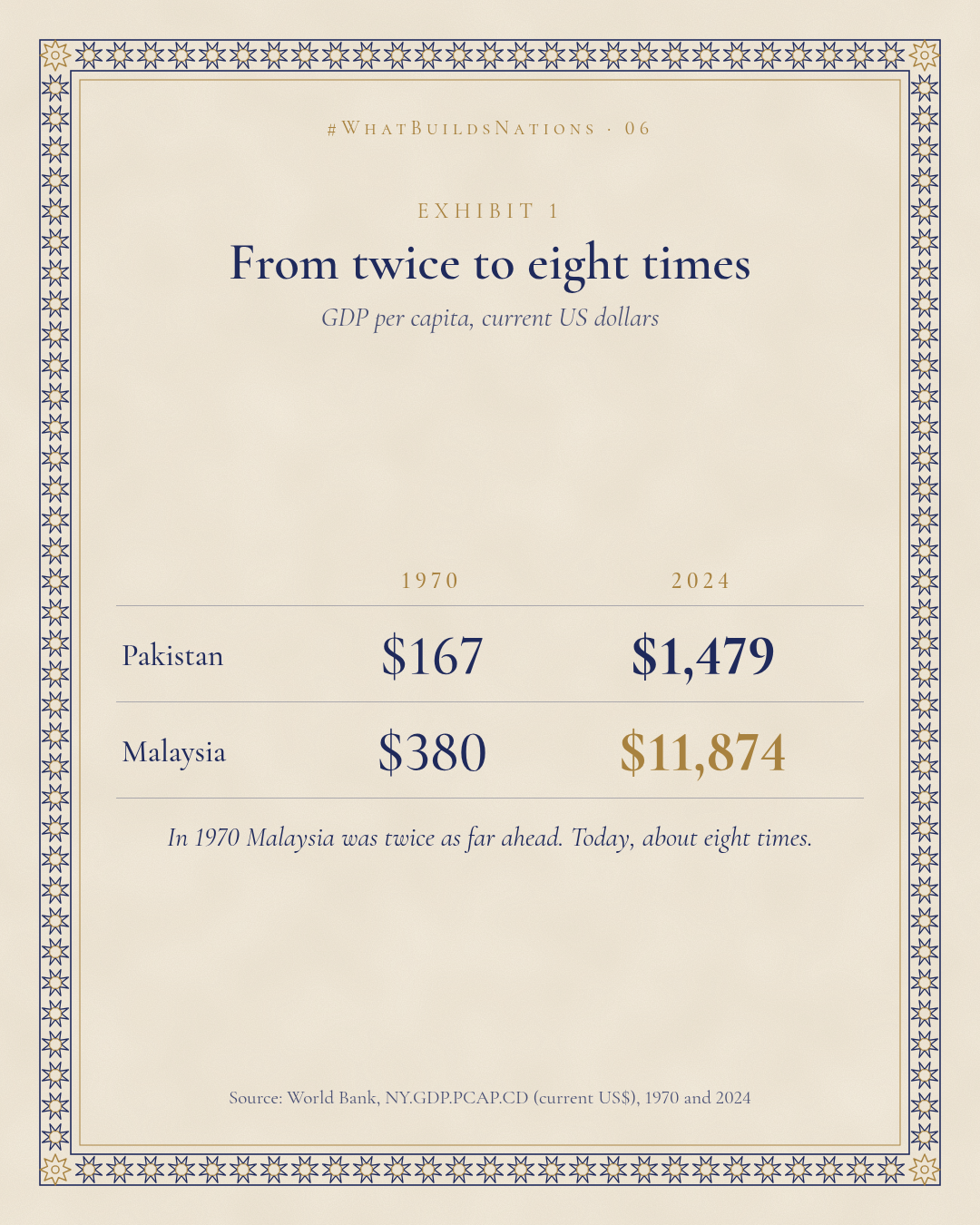
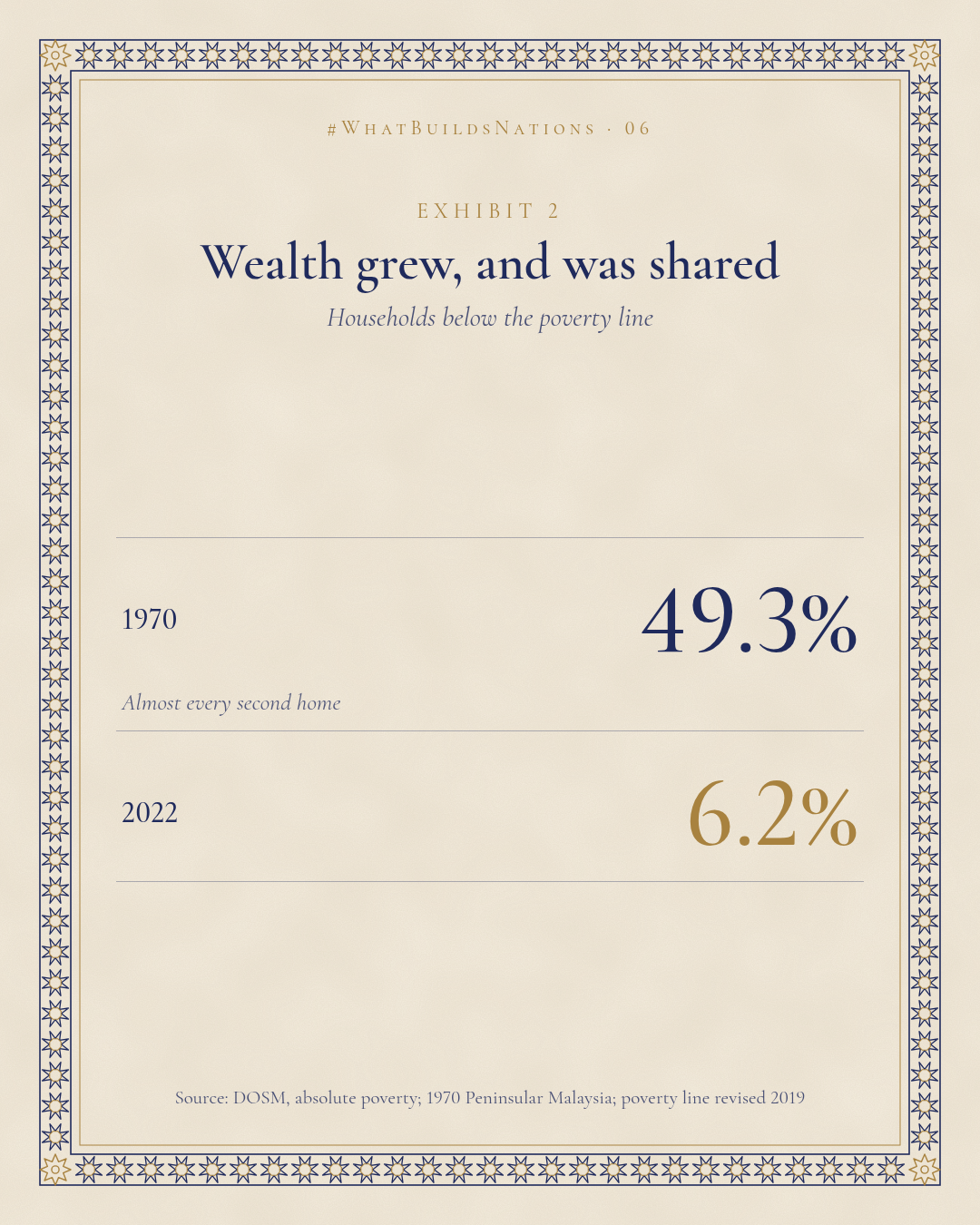
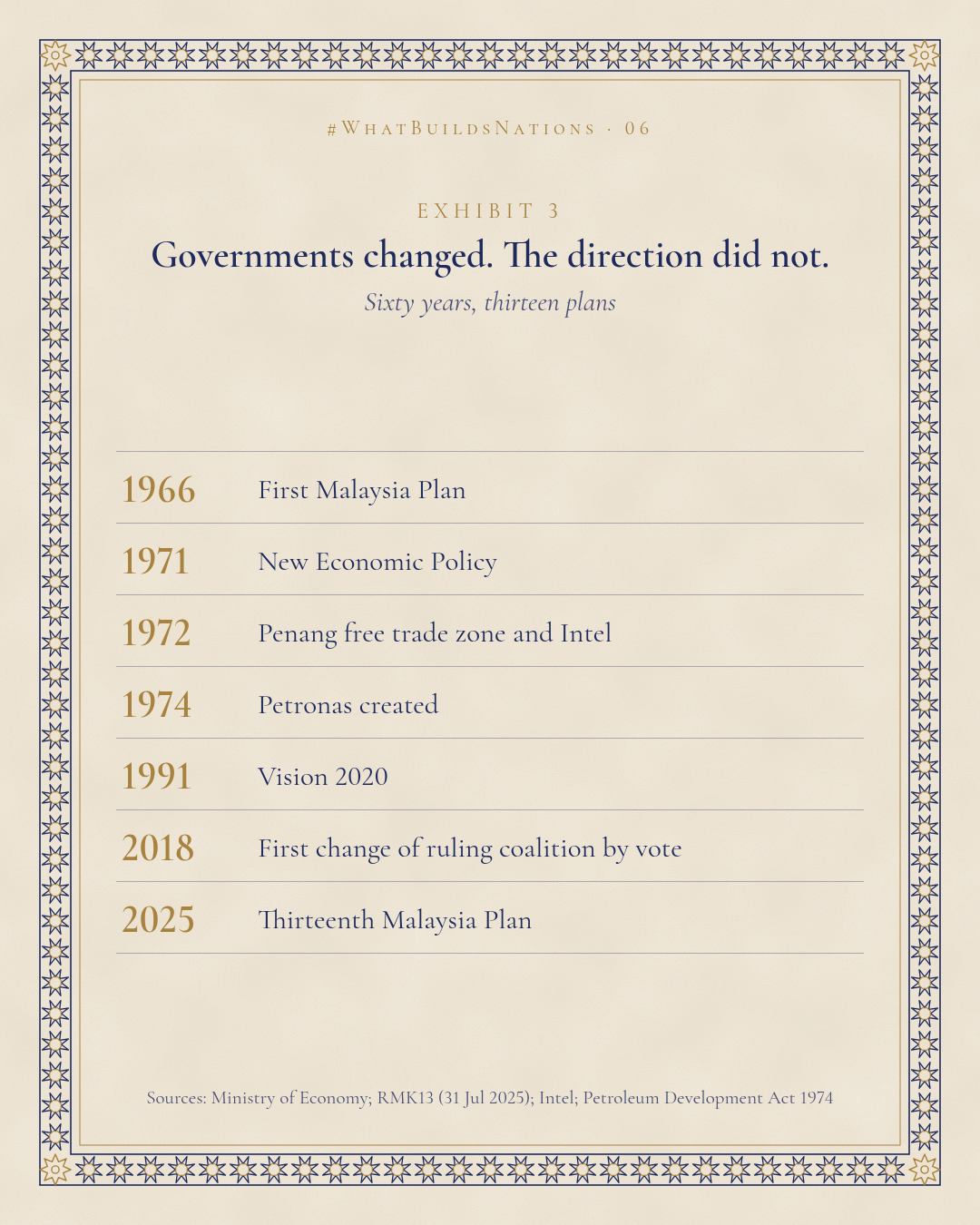
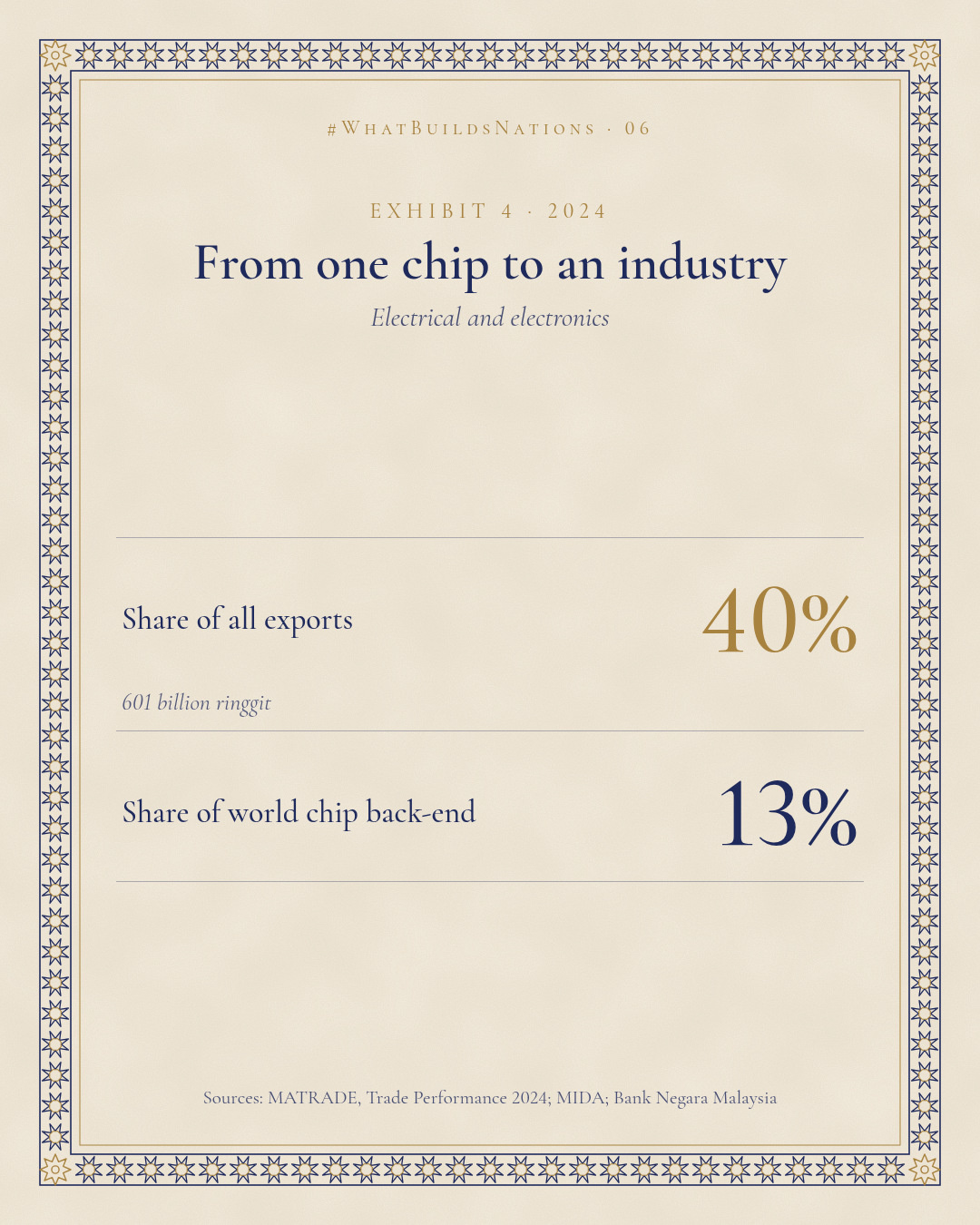
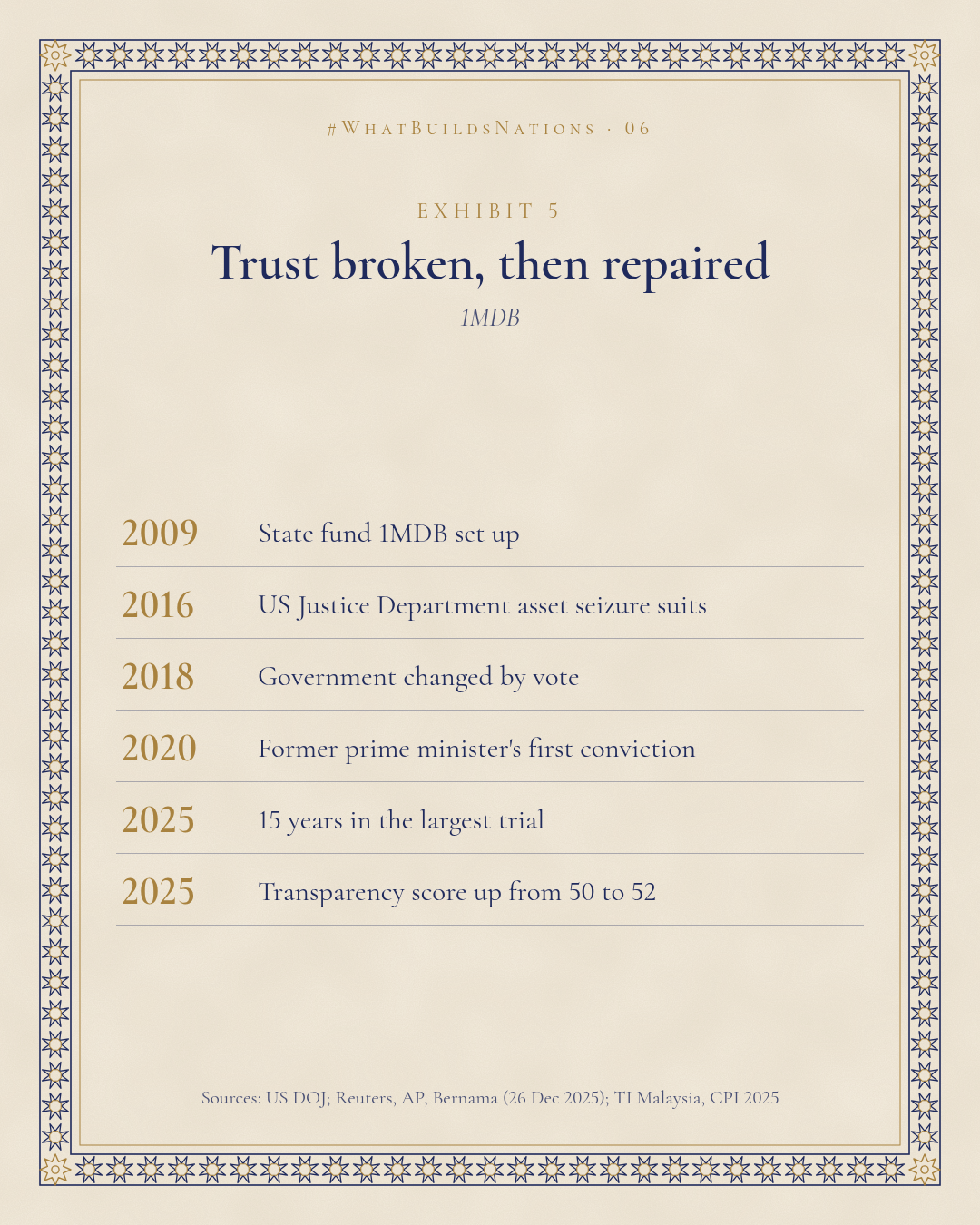
Exhibit 1. GDP per capita, current US dollars
| Year | Pakistan | Malaysia |
|---|---|---|
| 1970 | 167 | 380 |
| 1990 | 344 | 2,469 |
| 2000 | 642 | 4,084 |
| 2010 | 987 | 8,899 |
| 2024 | 1,479 | 11,874 |
Source: World Bank.
Exhibit 2. Households below the poverty line, percent
| Year | Malaysia |
|---|---|
| 1970 | 49.3 |
| 2022 | 6.2 |
The 1970 figure covers Peninsular Malaysia only, and the poverty line was revised in 2019. The trend is clear, but the two numbers are not on exactly the same basis. Source: Department of Statistics Malaysia.
Exhibit 3. Sixty years in sequence
| Year | What happened |
|---|---|
| 1966 | First Malaysia Plan |
| 1969 | Riots of 13 May |
| 1971 | New Economic Policy |
| 1972 | Bayan Lepas free trade zone; Intel’s first plant abroad |
| 1974 | Petronas |
| 1991 | Vision 2020 |
| 2018 | First change of ruling coalition by vote since independence |
| 2025 | Thirteenth Malaysia Plan, 2026 to 2030 |
Exhibit 4. From one chip to an industry
| 2024 | |
|---|---|
| Electrical and electronics exports | 601.18 billion ringgit |
| Share of total exports | about 40 percent |
| Share of world chip assembly, testing and packaging | about 13 percent |
Exhibit 5. Trust broken and repaired
| Year | What happened |
|---|---|
| 2009 | 1MDB set up |
| 2016 | US Department of Justice files suits to seize assets bought with 1MDB money |
| 2018 | Government changed by vote |
| 2020 | Former prime minister convicted in the first case |
| December 2025 | 15 years in the largest trial |
| 2025 | Transparency International score 52, up from 50 in 2024 |
The last word
Malaysia’s story begins with a wound.
After 13 May 1969 it had two roads. One, where every community scrambles to grab its share. The other, where everyone makes the cake bigger and brings those left behind forward.
It chose the second road, and for sixty years it wrote that choice into its plans and kept it.
Where it slipped, there is a lesson too. When help gets tied to identity, or a fund escapes oversight, trust breaks.
In 1970 Malaysia was twice as far ahead of us. Today, eight times.
That gap was not made in a day. It was made one five-year plan at a time, each kept by the next government too.
Three questions for you
- Can Pakistan write a five-year plan that survives a change of government? What would it take?
- Malaysia allocated help by race and later paid for it. On what basis should Pakistan help those left behind?
- After 1MDB, Malaysia began rebuilding trust through the ballot and the courts. How else does a nation’s broken trust come back?
Next in the series
Vietnam.
From war to factory.
How a country fighting hunger and inflation in 1986 became part of the world’s supply chain in thirty years. On Sunday.
Sources
- World Bank, World Development Indicators: GDP per capita, current US$ (NY.GDP.PCAP.CD) 1970 to 2024; GNI per capita, Atlas method, 2024; World Bank country classifications FY2026 (high-income threshold 13,935 dollars).
- Department of Statistics Malaysia (DOSM / OpenDOSM): absolute poverty 1970 (49.3 percent, Peninsular Malaysia) and 2022 (6.2 percent); Current Population Estimates 2024.
- The Malaysian Bar, “The tragedy of May 13, 1969”; Royal Malaysia Police, Peristiwa 13 Mei (official toll 196).
- Ministry of Economy Malaysia, A Brief History (First Malaysia Plan 1966 to 1970); RMK13 media statement, 31 July 2025.
- ISEAS Perspective 2021/36, Lee Hwok Aun, “Malaysia’s New Economic Policy and the 30% Bumiputera Equity Target”; Second Outline Perspective Plan (1970: 2.4 percent; 1990: 19.3 percent).
- Intel, “Embracing Global Production” (1972) and Intel Penang history; Bayan Lepas Free Industrial Zone.
- MATRADE, Trade Performance 2024 (E&E 601.18 billion ringgit, 39.9 percent); MIDA and Bank Negara Malaysia (13 percent of global back-end).
- Petroleum Development Act 1974 (Act 144); PETRONAS Integrated Report 2024 (72.4 billion ringgit to government).
- Mahathir Mohamad, “The Way Forward”, Malaysian Business Council, 28 February 1991.
- US Department of Justice, 1MDB civil forfeiture actions (from 2016); Reuters, AP and Bernama on the verdict of 26 December 2025.
- Transparency International Malaysia, Corruption Perceptions Index 2025 (score 52, rank 54 of 182).
- Waqas Khan Pitafi, “Make your word your bond”, waqaspitafi.com/writings/notes/your-word (29 May 2026).
Waqas Khan Pitafi
Founder and CEO of DevBatch since 2010. Sixteen years building one engineering services firm, from Pakistan, now in Dallas.
Keep reading
- October 25, 2026 · 11 min
ملائشیا: کئی قومیں، ایک سمت
قوموں کی تعمیر پر ایک سلسلہ، قسط 6: 1969 کے فسادات کے بعد ملائشیا نے دولت بڑھانے اور بانٹنے کا فیصلہ کیا۔ ساٹھ سال کے مسلسل منصوبے، Penang کے chips، Petronas اور Vision 2020۔ پھر نسلی کوٹے اور 1MDB۔ تسلسل اور اعتماد کا case۔
- October 22, 2026 · 14 min
بنگلہ دیش آگے کیسے نکلا
قوموں کی تعمیر پر ایک سلسلہ، قسط 5: 1972 میں بنگلہ دیش تقریباً ہر پیمانے پر پاکستان سے پیچھے تھا۔ 130 شاگرد، گاؤں گاؤں جاتی عورت کارکن، لڑکیوں کا وظیفہ اور کارخانوں میں لاکھوں عورتیں۔ فرق بنیاد سے پڑا۔