How to Adopt AI in a Mid-Market Business
Two public playbooks, one sector asymmetry, and a five-step framework for owners facing a generational technology shift.
Field notes for owners and operators. I first wrote this for my OPM 68 cohort at Harvard Business School. It draws on public accounts of AI deployments at named companies between 2024 and 2026, plus my own experience running three businesses across software services, platforms, and consumer e-commerce. It is meant to provoke discussion, not to prescribe action.
In the spring of 2026, the CEO of a mid-market services firm sat in a hotel room in Boston between sessions of an executive program at Harvard Business School, staring at two open browser tabs. The first showed a Klarna press release from February 2024 announcing that an OpenAI-powered assistant was doing the work of seven hundred customer service agents. The second showed a Bloomberg story, dated March 2026, reporting that Klarna had quietly begun rehiring those agents because customer satisfaction had collapsed.
On the same screen, in a third tab, was a memo published by Tobi Lütke, the founder and CEO of Shopify, in April 2025. “Reflexive AI usage is now a baseline expectation at Shopify,” the memo began. Teams could no longer ask for new headcount until they had demonstrated that the work could not be done with AI. AI fluency would be a question on every performance review.
The CEO ran three companies: a fifteen-year-old technology services firm built around an offshore delivery model, a software platform he had founded six years earlier, and a year-old consumer e-commerce business that he was still personally running. He had been quietly deploying generative AI inside all three businesses for the past eighteen months. The early signals were promising. But sitting in that hotel room, between an HBS class on trust and an HBS class on leadership, he could see clearly that the next twelve months were going to force a choice he had been deferring.
Klarna had treated AI as a substitute for people. JPMorgan, Moderna, and Shopify had treated AI as a teammate that the people had to learn to work with. The financial results were diverging. The reputational results were diverging faster. The question on the table was no longer whether to adopt AI. It was which posture to adopt, and at what speed, and how to explain it to a workforce that was equal parts curious, anxious, and exhausted.
This note is the framework he wished he had been handed when the question first arrived.
1. Two Public Playbooks
Between January 2024 and the spring of 2026, two distinct approaches to enterprise AI adoption played out in public, each with named protagonists, real numbers, and reputational consequences that boards and investors began to track explicitly. The cases below are not exhaustive, but they bracket the strategic choice that every mid-market CEO now faces.
Playbook A: AI as substitute
In February 2024, Klarna, the Swedish buy-now-pay-later company with roughly five thousand employees at the time, launched an OpenAI-powered customer service assistant. Within thirty days, the assistant handled 2.3 million customer chats, a volume Klarna executives publicly equated to the workload of seven hundred full-time agents. Average resolution time fell from approximately eleven minutes to under two. The company projected a $40 million profit improvement for 2024 based on the deployment alone. Klarna’s total headcount, which had stood at 5,527 in 2022, fell to 3,422 by the end of 2024.1
By early 2026, the story had changed. CEO Sebastian Siemiatkowski conceded publicly that “cost was a predominant evaluation factor” in how Klarna had organized its support function, and that this had “resulted in lower quality.”2 The company began rehiring human agents for complex and emotionally sensitive cases. Trade publications and enterprise AI analysts began referring to “the Klarna outcome” as a board-level cautionary term. By the time Klarna filed for its IPO, the AI assistant remained in production, but the framing had shifted from “AI replaced seven hundred agents” to “AI handles tier-one, humans handle the complex twenty percent.”
Playbook B: AI as teammate
In April 2024, Moderna, the mRNA biotechnology company, announced an expanded partnership with OpenAI and deployed ChatGPT Enterprise to its thousands of employees with an explicit organizational goal of 100% adoption within six months. Within two months, employees had created 750 custom GPTs across functions ranging from clinical research to legal contract review. Forty percent of weekly users were creating their own GPTs. The average user was holding approximately 120 conversations with the platform per week. By 2025, the GPT count exceeded 3,000, and Moderna had restructured its organization to merge Human Resources and Information Technology into a single “People and Digital” function.3 The head of AI products at Moderna, Brice Challamel, framed the philosophy in a single sentence: “We were never here to fill a bucket, but to light a fire.”
JPMorgan Chase pursued a parallel but larger version of the same approach. The firm built its own large language model platform, called LLM Suite, entirely in-house, and rolled it out to approximately 250,000 employees over the course of 2024 and 2025. Total annual technology investment reached $18 billion. The bank ran an internal training program called “AI Made Easy” that put tens of thousands of employees through structured curricula. Chief Analytics Officer Derek Waldron described the strategy as building “the world’s first fully AI-connected enterprise.” By late 2025, the bank reported 30 to 40 percent annual growth in measured AI benefits, approximately $1.5 billion in estimated annual value from AI initiatives, and 450-plus AI use cases in production.4
Shopify made the most explicit articulation of the underlying expectation. CEO Tobi Lütke’s April 2025 memo, titled “Reflexive AI usage is now a baseline expectation at Shopify,” placed AI fluency at the center of the company’s operating norms. Three of the memo’s provisions are worth quoting in their original form: “Before asking for more headcount and resources, teams must demonstrate why they cannot get what they want done using AI”; “AI competency will become a formal part of performance reviews and hiring decisions”; and, on the leader’s personal posture, “I use it all the time, but even I feel I’m only scratching the surface.”5 Shopify’s revenue grew between 20 and 40 percent year-over-year through this period while total headcount fell from 11,600 in 2022 to approximately 8,100 by the end of 2024.
These four companies operate in different industries. They differ in size by two orders of magnitude. They use different AI vendors and different deployment architectures. What they share is the framing: AI is treated as a capability the organization must build, not as a substitute the organization must purchase.
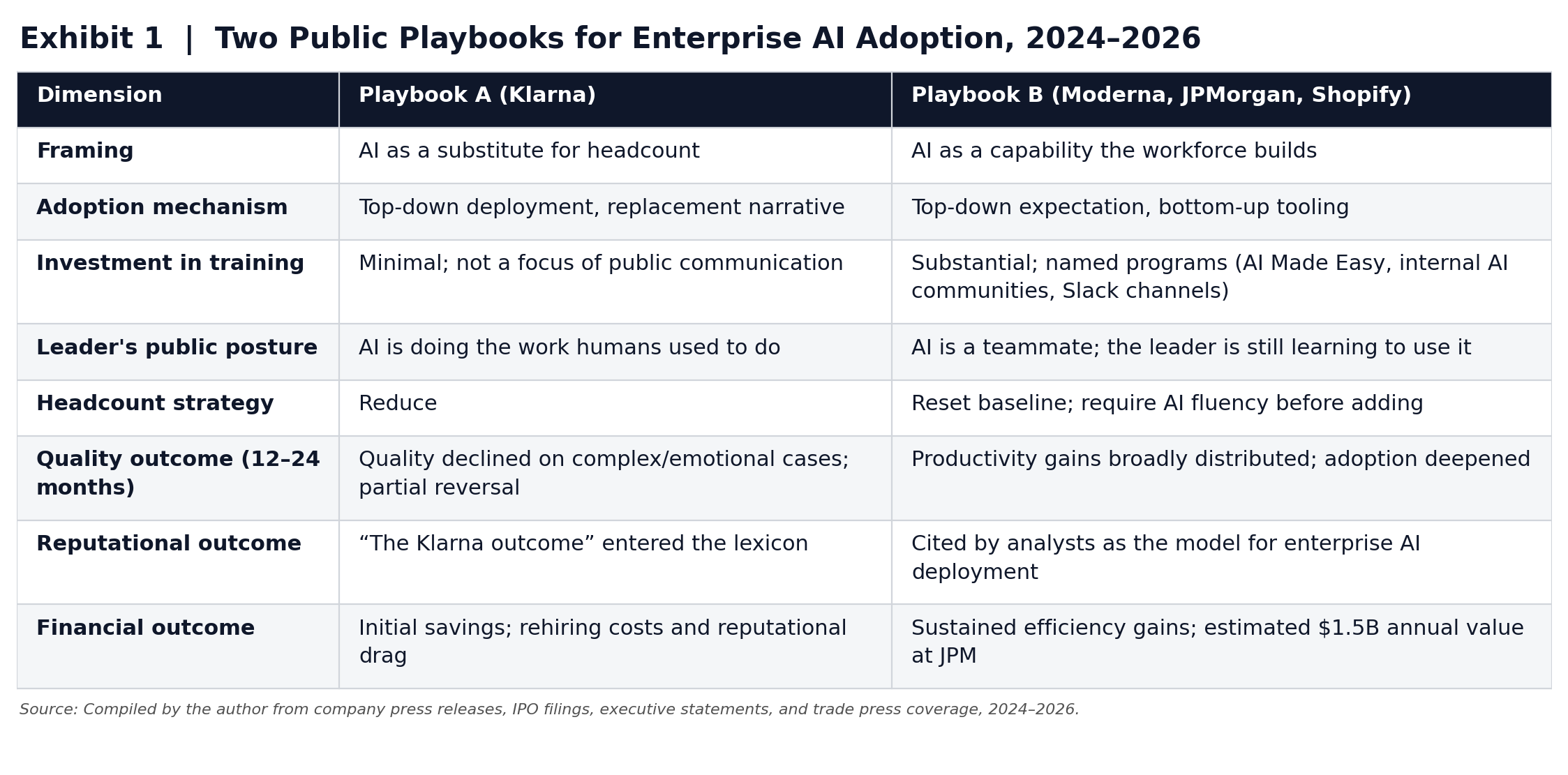
Exhibit 1. Two public playbooks for enterprise AI adoption, 2024 to 2026
2. Why the Substitution Playbook Breaks
The Klarna walk-back surprised many observers in 2026 because the early metrics had been compelling. Two and a third million chats handled in a single month. A 25 percent reduction in repeat contacts. Resolution times cut by more than 80 percent. If these were the only numbers that mattered, the experiment would have been judged a success. They were not the only numbers that mattered.
Three structural failures became visible only after the deployment had been running at scale for several months.
First, the bimodal quality problem. AI agents handled simple, repetitive customer queries, like order status, payment scheduling, and return tracking, with quality at or above the human baseline. The same agents handled complex, emotionally charged, or compliance-sensitive cases at substantially lower quality. The trouble was that the simple and complex cases came through the same inbound channel. Customers who arrived with a difficult dispute encountered the AI first, often received a confidently wrong answer, and only then escalated to a human, if the escalation pathway worked at all. The customer experience of the complex twenty percent was permanently degraded by the experience of meeting the AI first.
Second, the loss of institutional learning. Customer service is the most underrated source of strategic intelligence in any company. The agent who hears the same complaint forty times in a week is often the first to notice a product defect, a billing system bug, or a competitive shift in customer expectation. When AI handles those interactions, no human carries the pattern forward. The data exists in transcripts. The institutional memory does not.
Third, the reversal cost. By the time Klarna decided to rehire human agents in 2025 and 2026, the original cost-savings model had to be substantially revised. Recruiting, onboarding, and training new agents, at a moment when the company’s brand had been publicly associated with AI-driven layoffs, took longer and cost more than the original layoffs had saved. The true financial cost of a substitution strategy includes the cost of unwinding it if it fails. Few enterprises model that cost upfront.
The pattern is not unique to Klarna or to customer service. Any function where AI performs well at the average case but poorly at the edge cases, and where the edge cases are the ones that matter most to long-term reputation, is vulnerable to the same failure mode. Legal contract review. Diagnostic medicine. Sensitive HR decisions. Crisis communication. In each, the substitution playbook will report strong early metrics and then encounter the same wall.
3. What the Teammate Playbook Actually Requires
Reading the public accounts of Moderna, JPMorgan, and Shopify, it would be easy to conclude that the difference between their approach and Klarna’s was a matter of speed or generosity, that they were simply slower, or kinder, or better-resourced. That reading misses the structural choice. The teammate playbook is not the substitution playbook done at a slower pace. It is a different operating model with different commitments. Five commitments distinguish it.
A standing public expectation. Lütke’s memo did one thing that less effective rollouts fail to do: it made the expectation legible. Every Shopify employee knows that AI use is required, that they will be evaluated on it, and that headcount requests will be scrutinized against it. The standard does not drift across teams or managers. It is the same standard everywhere. Ambiguity on this point is what kills adoption in most companies.
A real investment in capability-building. JPMorgan’s $18 billion technology budget is the visible number. Less visible but equally important is the structured curriculum behind “AI Made Easy,” which segments employees by role and trains them on the AI use cases relevant to their daily work. Moderna ran an internal AI community and a Slack channel where employees shared what they had learned. The investment is not in the technology. The investment is in the workforce’s ability to use the technology.
Distributed authorship. The most striking number in the Moderna case is that 40 percent of weekly users built their own GPTs. The legal team built contract-summary GPTs. The HR team built benefits-navigation GPTs. The clinical team built dose-evaluation GPTs. Central IT did not build these tools for the functions. The functions built the tools for themselves. This is what Brice Challamel meant by lighting a fire instead of filling a bucket. It is also the move that scales fastest, because the supply of use cases is limited by the imagination of the entire workforce, not by the bandwidth of a central AI team.
Authentic leadership use. Lütke’s line, “I use it all the time, but even I feel I’m only scratching the surface,” is the most important sentence in his memo. The leader who mandates AI adoption without using AI personally will be detected within weeks. The leader who uses AI publicly, including in front of the team, including when the AI gets it wrong, models the learning curve that the workforce is being asked to climb. The mandate without the modeling reads as hypocrisy. The modeling without the mandate reads as a hobby. Both are required.
A workforce strategy that is not a layoff strategy. JPMorgan publicly projected a 10 percent reduction in operations headcount over several years, not through layoffs, but through attrition and redeployment as AI absorbed routine work. Moderna restructured rather than reduced. Shopify’s headcount fell, but the reduction was framed as a productivity story, not a replacement story. The distinction matters because the workforce reads the framing accurately. Where the framing is replacement, adoption slows because every employee has a personal interest in the technology failing.
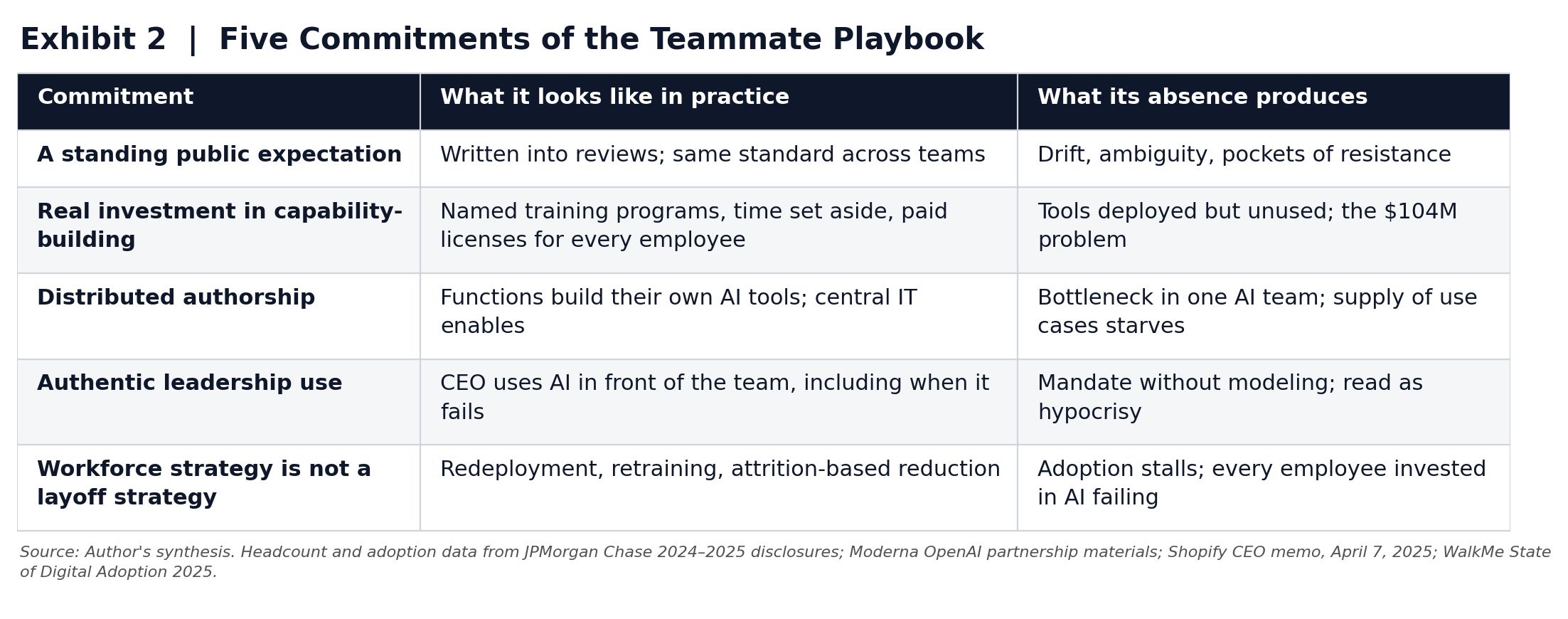
Exhibit 2. Five commitments of the teammate playbook
4. The Mid-Market Problem
The named examples in this note are large enterprises. JPMorgan has roughly 317,000 employees. Moderna has approximately 5,600. Shopify, the smallest of the three, has 8,100. The CEO of a mid-market business with fewer than 500 employees and revenues between $25 million and $300 million reads these case studies with one persistent question: how much of this is actually portable to my company?
The honest answer is that the principles are portable but the resources are not. A mid-market CEO will not have an $18 billion technology budget. There is no “AI Made Easy” curriculum waiting to be deployed. There is, in most cases, no Chief Data and Analytics Officer to lead the transformation. What there is, in most mid-market businesses, is a CEO who personally knows most of the senior managers, a culture that can change in a quarter rather than a decade, and a level of operational flexibility that no enterprise of scale can match. Three observations follow.
The standing public expectation costs nothing. Lütke’s memo was a writing exercise. It cost Shopify no incremental budget. A mid-market CEO can write the same memo to a team of fifty and have it land in twenty-four hours. The expectation is the cheapest of the five commitments, and the most underused.
Distributed authorship is more important at mid-market scale than at enterprise scale. A 5,000-person company can afford a central AI team. A 50-person company cannot. The mid-market CEO who waits for a centrally-built AI tool will wait forever. The CEO who tells five frontline managers to build their own first version of an AI tool for their function within the next two weeks will have ten working tools in a month. The mid-market scale advantage is that this experimentation can happen with no committee and no procurement cycle.
Authentic leadership use is harder, not easier, at mid-market scale. When the CEO of JPMorgan demonstrates an AI use case in a town hall, no employee assumes the CEO personally built it. When the CEO of a 50-person business demonstrates an AI use case, every employee assumes the CEO personally built it, and they are usually right. The mid-market CEO who has not personally used the technology cannot fake authentic use. There is nowhere to hide.
The fourth observation, which deserves a section of its own, is that the macroeconomic backdrop is not symmetric across industries.
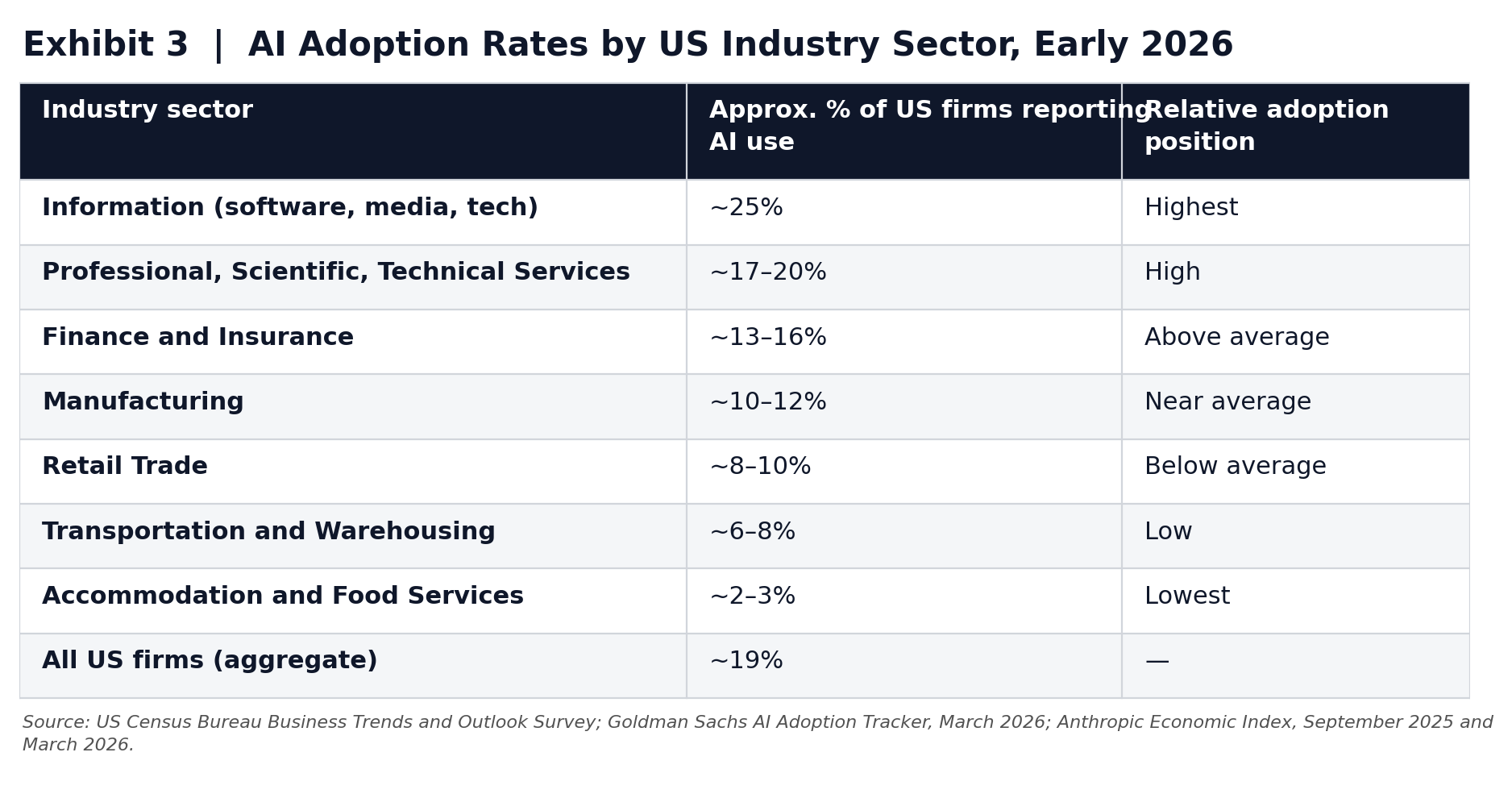
Exhibit 3. AI adoption rates by US industry sector, early 2026
5. The Sector Asymmetry
Exhibit 3 contains the most under-discussed fact in the current AI conversation. The Information sector, software companies, media businesses, technology platforms, has reached an AI adoption rate of roughly one in four firms. Accommodation and Food Services has reached one in forty. The gap between the highest and lowest sectors is approximately tenfold.
This is the inverse of what most casual analysis assumes. Casual analysis assumes that the high-adoption sectors are the ones with the most opportunity left to capture, because they are clearly leading. The opposite is true. The high-adoption sectors are the ones where AI is now table stakes. The low-adoption sectors are where the strategic asymmetry is largest. A snack company that runs an AI-driven supply chain in 2026 is competing against an industry where 97 percent of the businesses are still running on intuition and Excel. A regional restaurant chain that uses AI for menu engineering, demand forecasting, and labor scheduling is competing against an industry where almost nobody has the same tooling.
PepsiCo is the most documented example of what this can look like in practice. By early 2026, AI vision systems were scanning Frito-Lay chips on production lines and adjusting temperature, shape, and consistency in real time, generating savings of approximately $307,000 per production line. AI-enabled sensors and automation in smart factories had reduced energy consumption by 20 percent and water usage by 30 percent. A custom AI platform called Lay’s Smart Farm, built in partnership with Cropin, gave the company end-to-end visibility into potato sourcing across Asia-Pacific. A 2026 partnership with Siemens and Nvidia, using physics-based digital twins of warehouses and bottling plants, delivered a 20 percent improvement in throughput and a 10 to 15 percent reduction in capital expenditure during the pilot phase.6
None of this required PepsiCo to invent new AI. The platforms it used, large language models, computer vision systems, digital twin software, are commercially available. What PepsiCo did was decide, earlier than its competitors, that the sector asymmetry was the strategic opportunity, and that the AI adoption rate of the broader Food and Beverage sector was a competitive moat in the making. By the time the rest of the sector catches up, PepsiCo’s operational learning curve will be several years deep.
For a mid-market CEO in a low-adoption sector, the implication is direct. The window to convert AI adoption into a structural competitive position is open now and will close in the next eighteen to thirty-six months.
6. A Framework for the Mid-Market Decision
The CEO who returned to that hotel room in Boston after sessions on trust and leadership had, by the end of his second week on campus, settled on a framework. It was not original. Most of it was assembled from observation of the companies above and from a sequence of four classes on operations and technology. The framework follows.
Step one: write the standing expectation
Before any tool selection, the CEO writes, in their own voice, on their own letterhead, with their own signature, the standing expectation that AI is now part of how the company works. The memo names the expectation, names the timeline, names the consequence for performance review, and names the leader’s own commitment to use the tools personally. The memo is sent to the entire workforce on the same day.
Step two: fund the capability, not the tool
Paid licenses are inexpensive relative to people’s time. The budget item to defend is not the software seat. It is the four hours per week, per employee, for the first six weeks, that the workforce will need to invest in learning. The CEO who funds the licenses but not the time will produce $104 million of underused software, the figure WalkMe documented in its 2025 enterprise survey.7 The CEO who funds the time produces capability that compounds.
Step three: distribute the authorship
Within thirty days of the memo, every function head is expected to demonstrate one working AI workflow built by their team for their team. Not a vendor demo. A workflow the function actually uses. The CEO sees the demonstrations personally. The bar is competence, not polish. The signal is that this is now part of the function head’s job, not a side project.
Step four: model the use personally
The CEO uses AI visibly. In all-hands meetings. In one-on-ones. When drafting strategy documents. When the AI gets something wrong, the CEO points to it openly and says what they learned. The objective is to model the learning curve the workforce is being asked to climb. The cost of skipping this step is the highest in the framework. Without it, the memo reads as hypocrisy and the funding reads as compliance theater.
Step five: protect the workforce strategy
The CEO commits, publicly, that the goal of AI adoption is to make the existing workforce more capable, not to replace it. Where roles change, the company commits to retraining first and severance only as a last resort. This commitment may not survive contact with future financial reality. It must be the stated starting position regardless, because the workforce will read the framing accurately, and the framing will determine the pace of adoption more than any technology decision.
You can mandate AI use. You can fund AI tools. You can write the perfect memo. None of those things move the adoption rate inside a company by more than ten or fifteen percent. The thing that moves it from twenty percent to ninety percent is the workforce’s belief that the technology is being introduced to make them more capable, not to make them disposable. That belief is built or destroyed in the leader’s first three public statements on the subject.
The framework above is not a guarantee. It is the floor below which the substitution playbook becomes the path of least resistance. The CEO who establishes the floor early has the option of accelerating or slowing the rollout based on what they learn. The CEO who does not establish it will find, eighteen months in, that the workforce has quietly opted out and the productivity gains have not materialized.
7. The Decision the CEO Had Not Yet Made
This note has framed AI adoption as a binary between two playbooks. In practice, the choice is not binary. It is a sequence of smaller decisions taken under uncertainty, with the option to reverse most of them at modest cost. The substitution playbook is dangerous because, once announced publicly, it is the hardest to reverse. The teammate playbook is conservative because, once initiated, it leaves the option of accelerating into substitution later if the productivity gains justify it. The teammate playbook is, in the language of finance, the option-preserving move.
The CEO in the hotel room had not yet decided how aggressively to roll out the standing expectation across his three businesses. The technology services firm was the most ready: the workforce was technical, the use cases were obvious, the cost-structure pressure from the broader services industry was acute. The platform business was second: smaller team, slower decision cycle, but a clear set of internal workflows that AI could absorb. The consumer e-commerce business was the most uncertain: the team was small enough that any change would be visible, the use cases were narrower, and the founder was still personally running too much of the operation to credibly model a different posture.
He had not yet decided whether to send the same memo to all three businesses on the same day, or to stagger the announcements, or to pilot the framework in the technology services business and then extend it. He had not decided whether to set a six-month or a twelve-month timeline for the standing expectation. He had not decided how to phrase the workforce protection commitment in a way that was honest about the financial pressure he was under and credible to the workforce reading it.
By the time he returned home from Boston, those decisions would need to be made. The Klarna walk-back had taken roughly twenty-four months to play out in public. The companies that had made the right early calls in 2024 were two years into their compounding curve. The window for the mid-market to make its own early calls was open, and it was not going to stay open forever.
The framework was now on the table. The decision was still his.
Notes
-
Klarna Group, IPO filing, March 2025; Klarna Q1 2024 financial results, May 2024. Headcount progression reported in IPO filing as 5,527 (2022), 4,352 (2023), 3,422 (2024).
-
Siemiatkowski, S., remarks reported in CX Today and Business Insider, May 2025. The phrase “cost was a predominant evaluation factor” appears in multiple secondary sources citing Klarna’s internal review of the customer service strategy.
-
“Moderna,” OpenAI customer story, openai.com; Moderna Annual Report 2024; The Wall Street Journal coverage of Moderna’s AI rollout, 2024–2025.
-
JPMorgan Chase 2024 Annual Report; Waldron, D., interview with McKinsey and Company, October 29, 2024; CIO Dive coverage, September 2024; The Digital Banker, “LLM Suite drives AI transformation,” March 2026.
-
Lütke, T., “Reflexive AI usage is now a baseline expectation at Shopify,” internal memo published on the author’s X account, April 7, 2025. Shopify Annual Report 2024.
-
PepsiCo Annual Report 2025; Supply Chain Digital, January 2026; AgFunder News, October 2025; AI Magazine, July 2025.
-
WalkMe, State of Digital Adoption 2025, February 2025.
This is a discussion piece, not a Harvard Business School case study, and is not affiliated with HBS Publishing. It draws on publicly available company disclosures and trade press coverage. Any errors are mine.
Waqas Khan Pitafi
Founder and CEO of DevBatch since 2010. Sixteen years building one engineering services firm, from Pakistan, now in Dallas.
Keep reading
- October 10, 2026 · 8 min
How Pakistan Can Become Singapore
Part three of a Harvard-style case series on what builds nations: how a small island with no oil, no land and no water turned honest, capable government into its rarest asset, and what Pakistan can copy without copying its politics.
- October 10, 2026 · 10 min
پاکستان سنگاپور کیسے بن سکتا ہے
قوموں کی تعمیر پر ایک سلسلہ، قسط 3: ایک چھوٹا سا جزیرہ جس کے پاس نہ تیل تھا، نہ زمین، نہ پانی، اس نے ایماندار اور قابل حکومت کو اپنی سب سے بڑی دولت کیسے بنایا، اور پاکستان اس سے کیا سیکھ سکتا ہے۔