How Pakistan Can Become Singapore
Part three of a Harvard-style case series on what builds nations: how a small island with no oil, no land and no water turned honest, capable government into its rarest asset, and what Pakistan can copy without copying its politics.
November 1999. Dubai.
I was walking from one office to the next. A CV in my hand, a few days of money in my pocket.
No recommendation. No big name.
Then one office hired me as a programmer at 1,500 dirhams a month.
That day I understood something. Where the system works, even a stranger finds a way in.
Years later I read the case of a country that made that true for an entire nation.
Singapore.
This series
In June we talked about China.
Then we wrote a framework for Pakistan, five pillars.
Many of you said, give us concrete examples. Take one country at a time and show what we can actually learn from it.
So that is what we decided to do. A series. One country each time, and one lesson, for Pakistan.
At Harvard we read cases exactly this way. A leader, a hard decision, a few numbers, and at the end one question: what would you have done?
This series will run the same way.
Today, Singapore.
The day of decision
9 August 1965.
Singapore was separated from Malaysia. It had not asked for independence. Independence was thrust upon it.
That day Lee Kuan Yew went on television and could not hold back his tears.
The question in front of him was simple and brutal. How does a small island with nothing survive?
Let me set one thing straight first.
In 1965 Singapore had fewer resources than Pakistan.
A small island. No oil, no gas, no land, no farms. Even its drinking water came from Malaysia.
A divided population, Chinese, Malay, Tamil, different languages, different faiths.
And within a few years Britain announced it would close its military bases, which fed thousands of families. People said this country would not last.
Today the same Singapore is among the richest, cleanest and safest countries on earth. Its income per person is higher than America’s.
In one generation, from the Third World to the First.
The question is the same one we asked about China. How did this happen?
And the answer is not oil or land, because it had neither.
The rarest asset: an honest and capable government
This is Singapore’s biggest lesson.
A nation’s rarest wealth is not oil, not land, not population.
Its rarest wealth is an honest and capable government. Good governance.
Singapore had nothing else, so it built this one thing, and everything else came from it.
How? On a few simple principles.
One: no compromise on corruption
Singapore removed corruption from the top down, not the bottom up.
It had an independent bureau, the CPIB, set up under the British in 1952. In 1960 a tough new law gave it teeth. From then on it spared no one, from minister to clerk.
Powerful people were caught, and everyone saw it.
In 1986 a sitting minister was investigated for bribery. In 2024 a former minister was sent to jail for twelve months, a sentence nearly double what the prosecution had asked for.
At the same time it paid its officials well enough that stealing made no sense.
Its ministers were among the best-paid in the world, deliberately, so that the best people would come and honesty would not be expensive.
Today Singapore ranks among the least corrupt countries in the world. Third of 182 in the 2025 index. Pakistan is 136th.
Two: merit, not patronage
A place in government came through merit, not connections.
The best students were given scholarships, educated, and brought into government.
Public service was not a refuge for the weak. It was the arena for the best.
This is exactly what is upside down in Pakistan. Our best person often leaves, and the one with the recommendation stays.
Three: one law for everyone
In Singapore the law ran the same way for the rich and the poor.
A contract stayed a contract. An investor knew he would not be cheated.
That certainty pulled money and business into Singapore from all over the world.
Because money goes where it is safe.
Four: thinking twenty years ahead
Singapore did not think from election to election. It thought from generation to generation.
It spent heavily on education, and today its children lead the world in mathematics and science.
It made English the working language, so a divided nation could become one and connect with the world.
It gave its people public housing and settled different communities side by side so society would not fracture. Even today more than three in four Singaporeans live in those public flats, and over ninety percent of those households own their homes.
None of this was a day’s work. It was decades of steady thinking.
What it cost
This case would be incomplete if I did not name the price.
Singapore traded some freedoms for order.
Its press rarely takes on the government. The opposition stayed weak for decades. The laws are strict, and so are the punishments.
Many Singaporeans debate this themselves, and the debate is fair.
That is why I talk about Singapore’s governance, not its politics.
Now, Pakistan
Let me be clear about one thing.
Singapore is small, Pakistan is huge. Singapore was not a full democracy. Pakistan is one.
So we will not say copy Singapore’s politics. That is neither possible nor right.
We will say copy its governance, not its politics.
That governance is possible in a democracy too, the way India carried its reforms forward as a democracy.
And Pakistan does not need to boil the ocean.
Not every institution will be fixed in a day.
But take the few institutions that truly matter, lift them out of politics, staff them on merit, pay them well, and never look away from corruption at the top.
Build one small, clean, capable system, and let it compound for years.
That is what Singapore did. Not everything at once. A few things right, and then patience.
Lessons for Pakistan
Where does Singapore sit among the five pillars of the Pakistan framework?
Pillar five, the moral engine. This is Singapore’s whole story. Trust first, wealth after.
Pillar one, continuity. One direction, for decades. No reset with every new government.
Pillar two, the foundation. First every child’s schooling and every family’s home, then the shine.
And three concrete steps for us:
One. Pick just three institutions and bring them to Singapore’s standard. Merit hiring, market pay, and an open scorecard.
Two. An accountability body free of politics, known for one thing: it caught someone powerful, and everyone saw it.
Three. The sanctity of contract. A commercial case should be settled in months, not years.
This is what we called the moral engine in the Pakistan framework.
Singapore is living proof that this one pillar alone can carry a small nation from the Third World to the First.
Exhibits
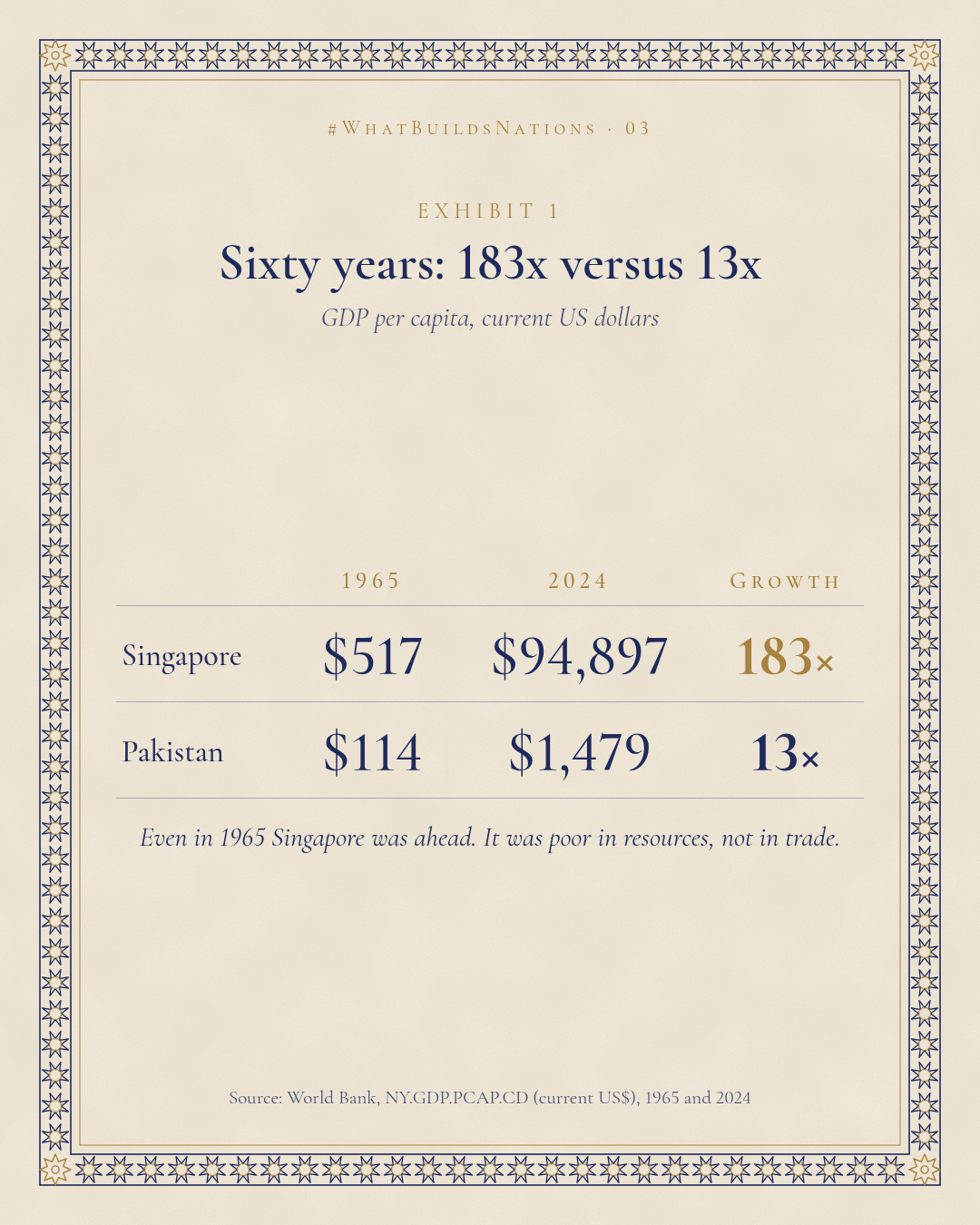
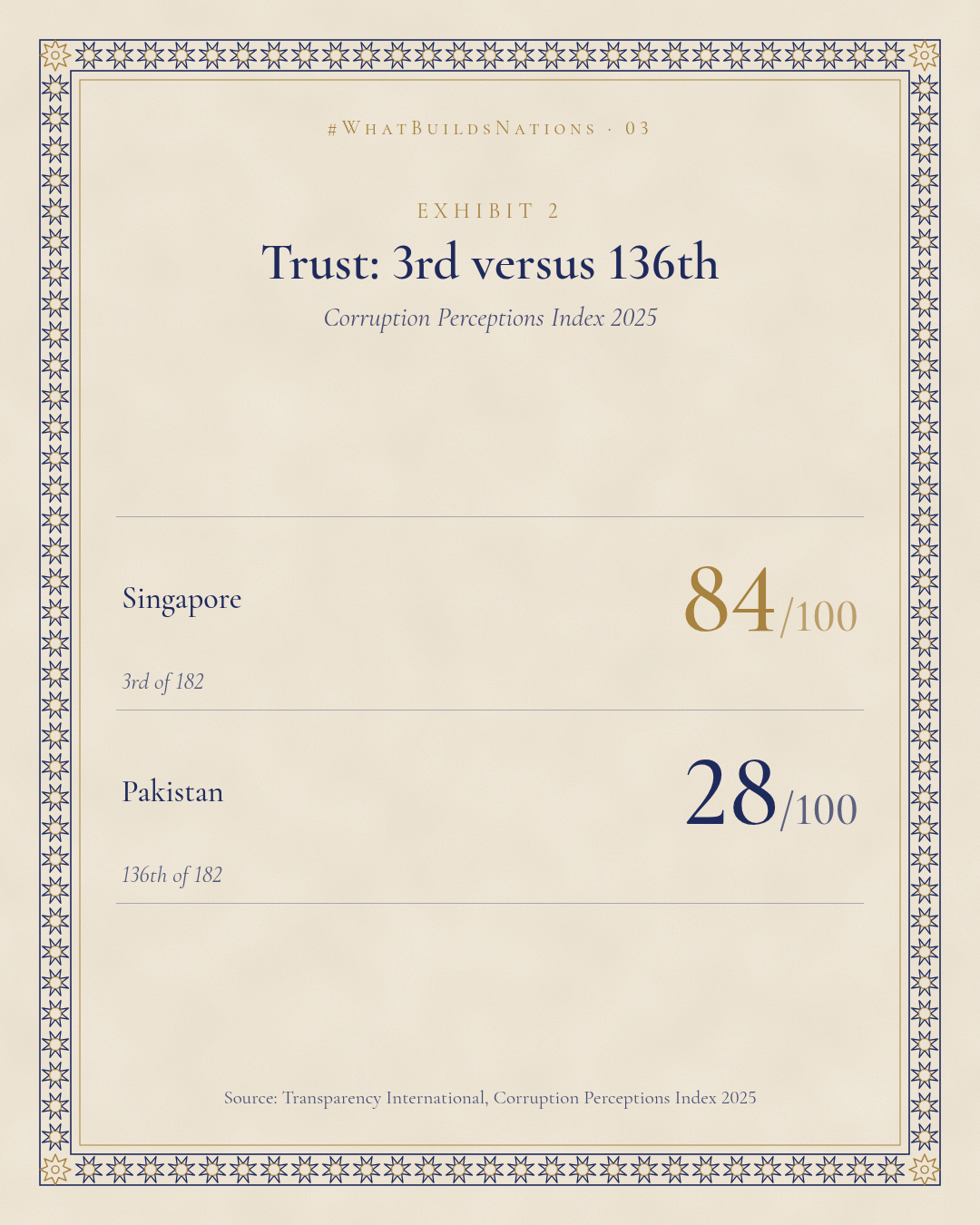
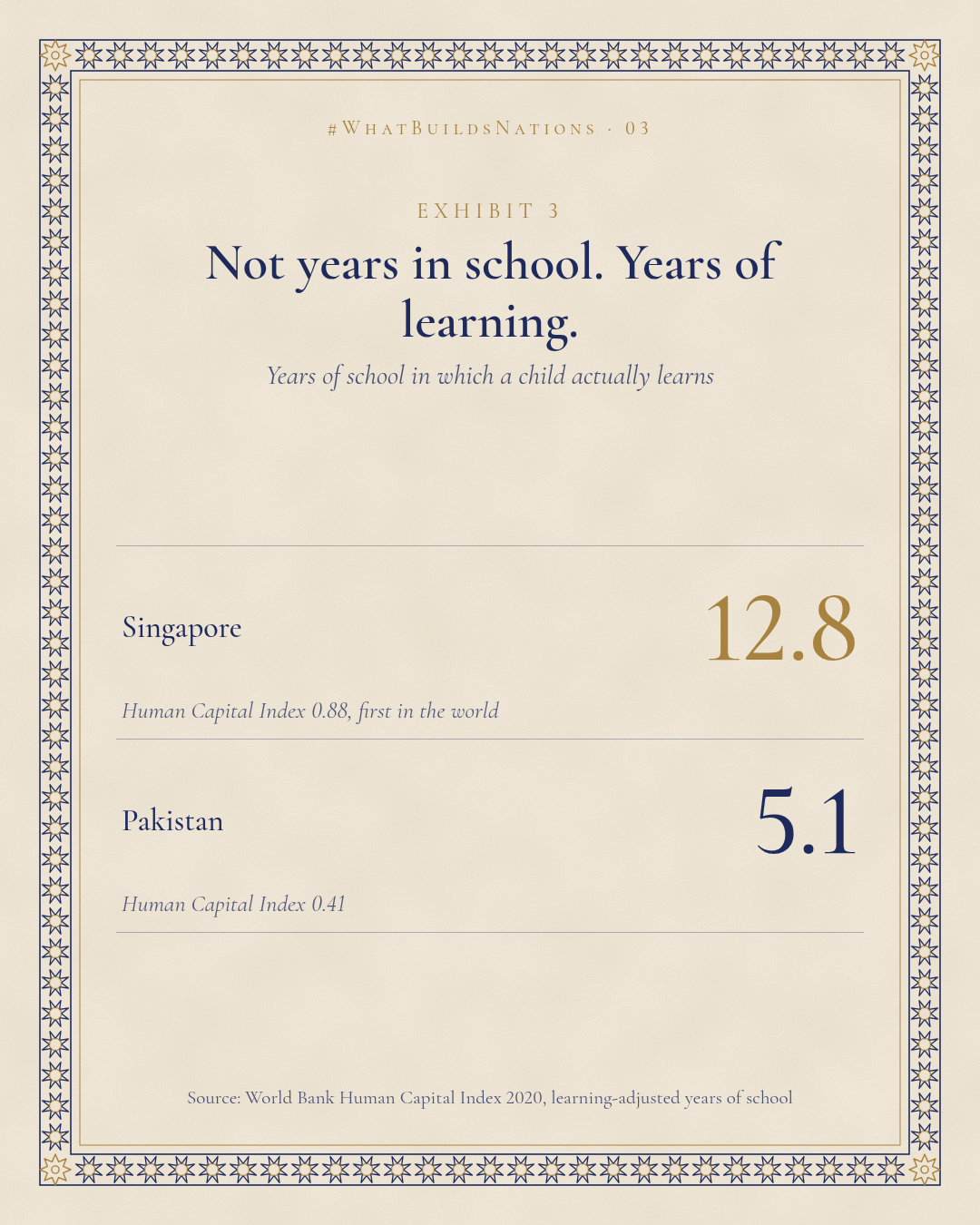
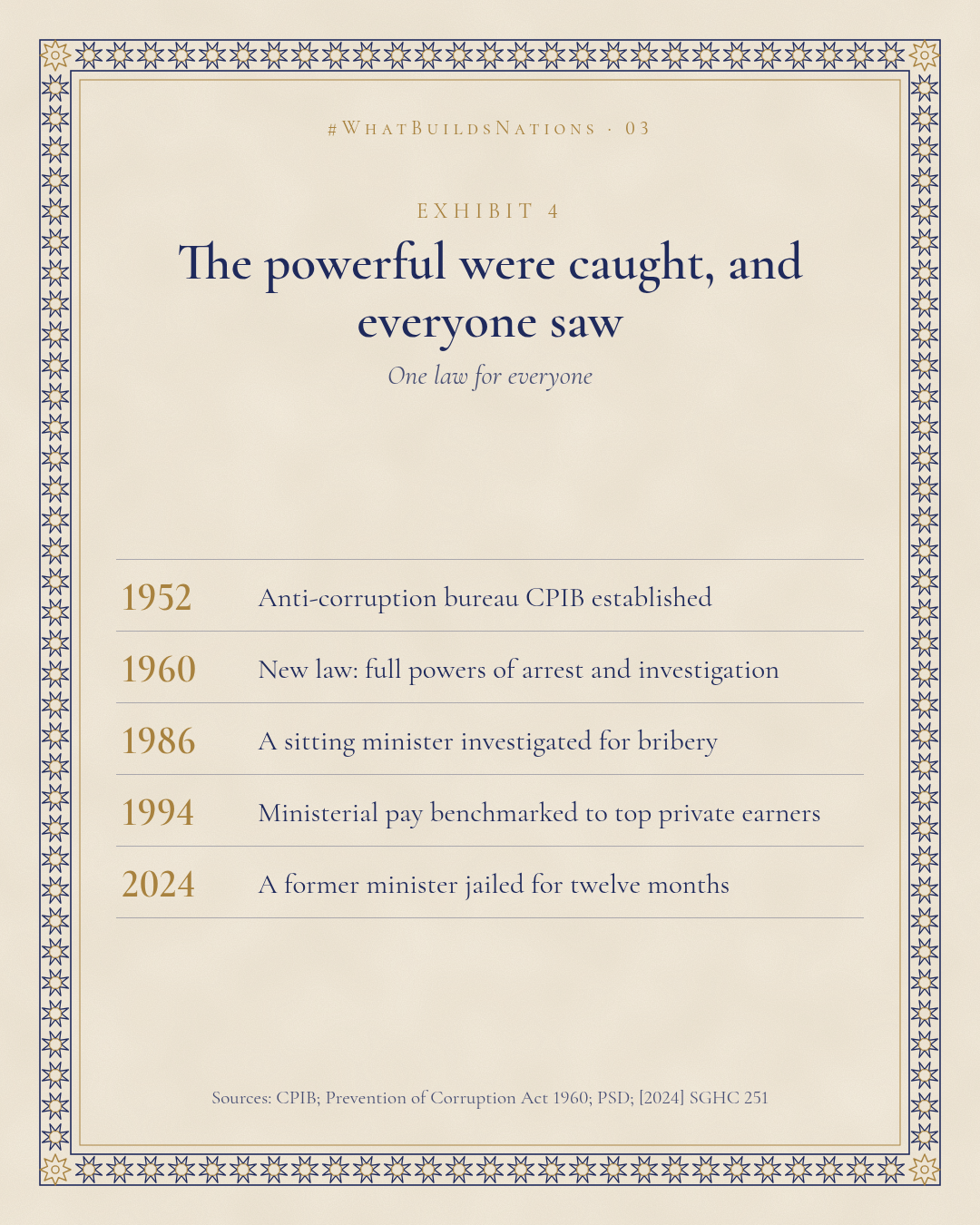
Exhibit 1. GDP per capita, current US dollars
| Country | 1965 | 2024 |
|---|---|---|
| Singapore | 517 | 94,897 |
| Pakistan | 114 | 1,479 |
| United States | 3,818 | 86,170 |
An honest note. Even in 1965 Singapore was ahead of Pakistan in income per person. It was poor in resources, not in trade. But over the next sixty years its income grew about 183 times, and ours about 13 times. Nominal dollars, not adjusted for inflation. Source: World Bank.
Exhibit 2. Corruption Perceptions Index 2025 (Transparency International)
| Country | Rank | Score (of 100) |
|---|---|---|
| Singapore | 3 of 182 | 84 |
| Pakistan | 136 of 182 | 28 |
Exhibit 3. Human capital, 2020 (World Bank Human Capital Index)
| Country | Human Capital Index | Learning-adjusted years of school |
|---|---|---|
| Singapore | 0.88, first in the world | 12.8 |
| Pakistan | 0.41 | 5.1 |
In other words, of all the years a Pakistani child spends in school, the actual learning adds up to about five.
Exhibit 4. Housing, 2024 (HDB)
76.4 percent of Singapore residents live in public HDB flats, and more than nine in ten of those households own their homes.
Exhibit 5. One law for everyone: a timeline
| Year | What happened |
|---|---|
| 1952 | CPIB established |
| 1960 | Prevention of Corruption Act gives it powers of arrest and investigation |
| 1986 | A sitting minister investigated for bribery |
| 1994 | Ministerial pay benchmarked to top private-sector earners |
| 2024 | A former minister jailed for twelve months |
The last word
Singapore’s real miracle was not its wealth.
The real miracle was a decision: we will run this place honestly, however hard it is.
The wealth followed that decision on its own.
That decision is within reach of any nation. It needs no oil and no land. Only intent.
The question is whether Pakistan wants to make it. Whether it is ready to give up patronage.
Because that is the price. And Singapore showed that the price is worth paying.
Three questions for you
- If you could pick only three Pakistani institutions to bring to Singapore’s standard, which three would you choose, and why?
- Can a good salary buy honesty? Or does it also need the fear of being caught?
- Singapore traded some freedoms for order. Can a democracy reach the same result without giving up freedom? How?
Next in the series
South Korea.
In 1965 the average Pakistani earned more than the average Korean.
Today Korea’s income per person is about twenty-four times ours.
How? In the next part.
Sources
- World Bank, World Development Indicators: GDP per capita, current US$ (NY.GDP.PCAP.CD), 1965 and 2024.
- Transparency International, Corruption Perceptions Index 2025 (February 2026); CPIB press release, 10 February 2026.
- World Bank, Human Capital Index 2020 (HD.HCI.OVRL, HD.HCI.LAYS).
- Housing and Development Board, Key Statistics FY2024; Sample Household Survey 2023/24.
- CPIB, “Our Heritage”; Prevention of Corruption Act 1960 (Singapore Statutes Online).
- Public Service Division, Ministerial Salaries; White Paper, Salaries for a Capable and Committed Government (2012).
- Public Prosecutor v Iswaran, [2024] SGHC 251; Reuters and CNA, 3 October 2024.
- OECD, PISA 2022 Results.
- Lee Kuan Yew, From Third World to First (2000); National Archives of Singapore, press conference of 9 August 1965.
Waqas Khan Pitafi
Founder and CEO of DevBatch since 2010. Sixteen years building one engineering services firm, from Pakistan, now in Dallas.
Keep reading
- October 10, 2026 · 10 min
پاکستان سنگاپور کیسے بن سکتا ہے
قوموں کی تعمیر پر ایک سلسلہ، قسط 3: ایک چھوٹا سا جزیرہ جس کے پاس نہ تیل تھا، نہ زمین، نہ پانی، اس نے ایماندار اور قابل حکومت کو اپنی سب سے بڑی دولت کیسے بنایا، اور پاکستان اس سے کیا سیکھ سکتا ہے۔
- July 6, 2026 · 3 min
What four thousand monthly salaries actually mean
I am not an inventor. I am not building something the world has never seen. I run a services firm, and the way I think about its impact is through the salaries it has paid out, one month at a time, for sixteen years.